
As South Africa grapples with economic challenges, a quiet yet promising narrative is emerging in the consumer sector that could redefine investment strategies in the coming years. While negative sentiments abound regarding the country’s financial health, several indicators suggest that a recovery is on the horizon. With interest rates trending downward, inflation targets being revised, and a strengthening currency, the landscape may be more favorable for consumers and investors alike than it initially appears.
In the midst of global economic uncertainty, South Africa’s local market is beginning to show signs of resilience. Although interest rates are decreasing at a slow pace, this shift is significant for consumers who benefit from lower borrowing costs. Furthermore, the recent adjustments to inflation targets signal potential for even lower long-term interest rates. This is evident in the flattening of long-bond yields, which suggests a more stable financial environment.
Additionally, the Rand has strengthened against leading currencies, and the slump in oil prices is providing further relief to consumers, contributing to a more favorable economic climate. Another positive aspect is China’s decision to redirect surplus exports to markets beyond the United States. This shift may create downward pressure on inflation, benefiting South African consumers. Moreover, the public sector is gradually making strides in improving infrastructure, which can help reduce costs for consumers over time.
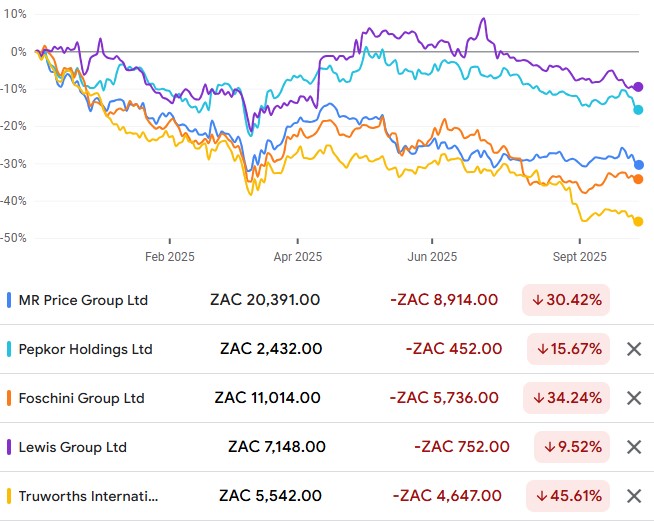
Despite these positives, local discretionary retailers have faced challenges, with many share prices declining year-to-date. Notably, brands like Truworths, Foschini, and Lewis, along with Pepkor—which has aggressively expanded its credit offerings—have not performed as well. However, Mr Price stands out in this environment as a predominantly cash-based and value-oriented retailer that has chosen to focus on enhancing its domestic market presence rather than pursuing large international acquisitions.
Mr Price’s strategy of investing in related local retail opportunities, such as its recent acquisition of Power Fashion, has started to yield positive results. This approach allows the company to increase density within its existing supply chains, a tactic that has historically proven more successful for South African retailers than attempting to expand abroad. As a result, Mr Price has maintained a robust balance sheet characterized by net cash, steady growth in like-for-like sales, and significant free cash flow generation.
One particularly compelling aspect of Mr Price’s financial health is its “Free Cash Flow-to-Enterprise Value Yield.” This metric, which divides the company’s free cash flow by the sum of its market capitalization and net debt, indicates how much cash the company’s operations generate relative to its funding sources. Currently, investors can obtain a higher free cash flow yield from Mr Price than the yield offered by South Africa’s 10-year government bond. This presents a unique opportunity for investors seeking more attractive returns in a challenging economic environment.
Furthermore, historical data suggests that Mr Price’s share price tends to perform well when its free cash flow yield exceeds that of the local 10-year bond yield. This trend presents a potential investment strategy for those looking to capitalize on undervalued opportunities within the South African market.
Key points to consider in this context include:
1. **Economic Shifts**: The decline in interest rates and inflation targets presents a more favorable environment for consumer spending.
2. **Strategic Positioning**: Mr Price’s focus on enhancing its local retail offerings rather than pursuing aggressive international expansion has proven effective.
3. **Financial Health**: The company’s robust free cash flow generation and net cash position highlight its strength in the current market.
4. **Investment Potential**: With Mr Price offering a higher free cash flow yield than government bonds, it may be an attractive option for investors.
For traders and investors, the situation in South Africa presents a unique mix of challenges and opportunities. While some sectors may struggle, companies like Mr Price, which are well-positioned to capitalize on the evolving consumer landscape, could provide significant upside.
In conclusion, while South Africa faces numerous economic hurdles, the consumer story unfolding within the market—especially through companies like Mr Price—offers a glimmer of hope. With a focus on local growth, financial resilience, and a favorable economic backdrop, investors may find that this is the right time to explore emerging opportunities in the South African consumer sector. As the market continues to evolve, keeping an eye on these developments will be crucial for making informed investment decisions.