
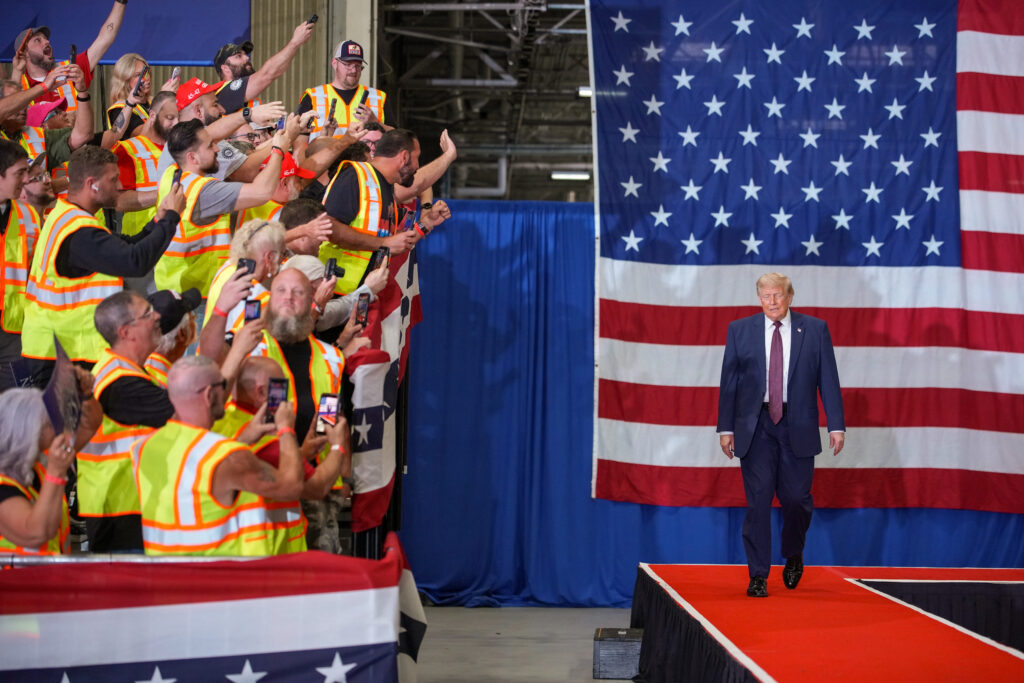
In a bid to reconnect with voters ahead of the upcoming midterm elections, former President Donald Trump has re-emphasized his protectionist trade policies during a recent visit to Pennsylvania. The backdrop of this campaign stop is significant, as it comes on the heels of an interim agreement aimed at de-escalating tensions between the United States and Iran. With the economy at the forefront of voters’ minds, Trump’s message focused on economic recovery and his administration’s efforts to stabilize energy prices, all while navigating the challenges posed by his trade agenda.
Trump’s visit to the manufacturing hub of Macungie, Pennsylvania, marked a strategic attempt to rally support in a battleground state crucial for Republican prospects in the upcoming elections. The former president sought to shift public attention from the recent conflicts and the associated rise in energy costs to a narrative of economic rejuvenation. “We’re trying to work out a deal that’s fair,” he declared, projecting optimism about the potential decrease in oil prices and its ripple effects on the overall economy.
At the heart of Trump’s message is the assertion that the US economy is primed for unprecedented growth now that tensions with Iran are easing. He highlighted the impact of tariffs imposed on various imports, including metals and automobiles, which he claims helped reduce the trade deficit with China. This emphasis on tariffs is a central pillar of Trump’s economic doctrine, which aims to protect American workers and industries from what he describes as predatory foreign competition.
However, Trump’s trade policies have not been without controversy or consequence. The tariffs, while intended to shield American jobs, have also led to increased costs for manufacturers, as evidenced by the challenges facing Mack Trucks. The parent company, Volvo Group, has announced layoffs at several facilities, including the Macungie plant, citing uncertainty stemming from Trump’s trade measures. This situation highlights the complex interplay between protectionist policies and their real-world ramifications for American workers.
As Trump continues to advocate for his economic vision, several key points emerge that voters and investors alike should consider:
1. **The Role of Tariffs in the Economy**: While tariffs are designed to protect domestic industries, they can also lead to higher prices for consumers and disrupted supply chains. Understanding this trade-off is essential for voters evaluating Trump’s economic policies.
2. **Energy Prices and Inflation**: The president’s focus on oil prices is particularly relevant given recent spikes linked to geopolitical tensions. The promise of lower energy costs can resonate with voters facing rising expenses, but the actual impact will depend on broader market conditions.
3. **Voter Sentiments on the Economy**: Current polls indicate that many voters are dissatisfied with the economic landscape, particularly regarding housing costs, healthcare, and grocery prices. As these issues weigh heavily on the electorate, addressing these concerns will be vital for any political campaign.
4. **Impact on the Manufacturing Sector**: The challenges faced by companies like Mack Trucks illustrate the mixed results of Trump’s trade policies. While he touts job creation and factory revitalization, the reality is often more complicated, with layoffs and uncertainty also affecting workers.
For traders and investors, Trump’s approach to trade presents both opportunities and risks. On one hand, sectors such as manufacturing and energy may experience volatility based on policy changes and international relations. On the other hand, investors should remain vigilant about potential backlash from tariffs, which could affect global supply chains and consumer prices.
In conclusion, as the midterm elections approach, Trump’s trade agenda will be a double-edged sword for Republican candidates. While he aims to position himself as a champion of American workers, the realities of his policies may complicate this narrative. Voters are keenly aware of their economic circumstances, and their perceptions will likely play a crucial role in determining the outcomes of the elections. As this political landscape evolves, understanding the implications of trade policies, energy prices, and voter sentiment will be critical for anyone engaged in the financial markets or the broader economic conversation.