
The South African economy has seen its fair share of challenges, but a closer look reveals that there may be a subtle yet positive narrative emerging within the consumer sector. While it’s easy to focus on the negative aspects of the economy, such as high unemployment rates and slow economic growth, several indicators suggest that a turnaround might be in the works. As interest rates begin to decline, inflation targets are adjusted downward, and certain sectors of the market show resilience, consumers could find themselves in a more favorable position over the coming years.
To fully appreciate this potential shift, one must consider several key economic factors at play. First and foremost, the South African Reserve Bank has started to lower interest rates, albeit at a gradual pace. This is critical because lower interest rates can lead to cheaper borrowing costs for consumers, effectively boosting spending power. Additionally, the adjustment of inflation targets provides a further backdrop for falling long-term rates, as evidenced by the recent flattening of long-bond yields in the country.
Another positive element is the strength of the South African Rand, which has recently shown resilience against major currencies. A stronger Rand can help reduce the cost of imports, including essential goods and services, giving consumers greater purchasing power. Furthermore, the global oil prices have taken a dive, providing further relief to consumers as fuel costs drop, thus lowering transportation expenses that can have a ripple effect on the overall cost of goods.
The changing dynamics of international trade also play a role in this consumer narrative. With China redirecting its surplus exports to markets beyond the United States, South Africa could benefit from reduced inflationary pressure. This has the potential to keep prices stable or even decrease them, which would be a boon for consumers who have been grappling with rising costs.
On the local front, the public sector seems to be making strides towards improving infrastructure. While progress may be slow and often frustrating, any enhancements in public services can lead to decreased operational costs for businesses. This, in turn, can translate into more affordable prices for consumers—essentially putting more money back into their pockets.
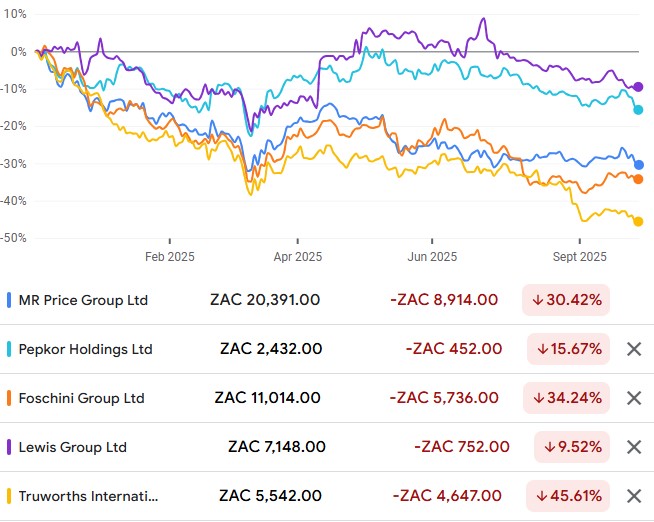
Despite these positive signals, it is important to note that local discretionary retailers have not fared well in the stock market this year. Many have seen their share prices decline, leading to skepticism among investors. However, one standout performer in this space is Mr Price, a retailer that focuses predominantly on cash-based transactions. Unlike many of its competitors, Mr Price has not aggressively pursued offshore expansion; instead, it has concentrated on enhancing its local offerings and strategically acquiring related businesses, such as Power Fashion.
Mr Price’s approach is noteworthy because it demonstrates a keen understanding of the South African retail landscape. Retail business models often struggle to translate successfully into international markets, making a hyper-local focus more viable. The company’s balance sheet remains robust, with a net cash position and increasing like-for-like sales. Furthermore, Mr Price has been generating substantial free cash flow, which provides a solid foundation for future growth.
Interestingly, if we analyze Mr Price’s Free Cash Flow-to-Enterprise Value Yield—a metric that compares the free cash flow generated by a company to its overall market valuation—it reveals that investing in Mr Price may currently yield a better return than South African government bonds. This could indicate that the stock market has undervalued this retailer, offering a compelling investment opportunity for those willing to look beyond the broader market sentiment.
As we chart the course of the South African economy, it is essential for traders and investors to remain vigilant and identify opportunities within the consumer sector. The interplay between declining interest rates, a resilient Rand, and improving public services creates a fertile ground for potential growth in consumer spending. Mr Price exemplifies how a local retailer can thrive even in challenging times, serving as a potential model for others in the industry.
In conclusion, while South Africa faces significant challenges, the glimmers of hope within the consumer market cannot be overlooked. As certain economic indicators point towards improvement, consumers and investors alike may find opportunities to capitalize on a gradually improving landscape. The story of Mr Price serves as a reminder that resilience and strategic focus can yield positive outcomes, even when the broader economic narrative appears uncertain. By staying informed and adaptable, investors can navigate these complexities and potentially reap the rewards in the years to come.