
In recent times, the South African banking sector has been under the spotlight, particularly following the release of quarterly earnings by several banks listed on the Johannesburg Stock Exchange (JSE). With notable fluctuations in share prices, analysts and investors have been dissecting the merits and valuations of these financial institutions. Among the most discussed is Capitec Bank, which despite reporting impressive financial results, trades at a significantly higher valuation compared to its peers. This discrepancy raises critical questions about how we understand bank valuations and what factors truly drive their worth.
At its core, a bank’s value can be distilled into a few key components, primarily revolving around its access to capital and how effectively it utilizes that capital to generate profits. While banks often present themselves with attractive branding and grand offices, the essence of their business lies in the banking license they hold, which grants them access to capital at a relatively low cost. This low-cost capital is typically leveraged for lending, where banks earn a profit by charging higher interest rates on loans than what they pay on deposits or other sources of funding.
The crux of the banking business model hinges on the concept of the interest rate spread. This spread is the difference between the interest earned on loans and the interest paid on deposits. Banks function essentially as balance sheets with liabilities funded at lower rates being used to create assets that yield higher returns. This unique position allows banks to generate profits without requiring substantial equity funding. Hence, the valuation of banks using a Price-to-Book (P/B) ratio can be insightful, but it must be contextualized within the bank’s effectiveness in utilizing its balance sheet.
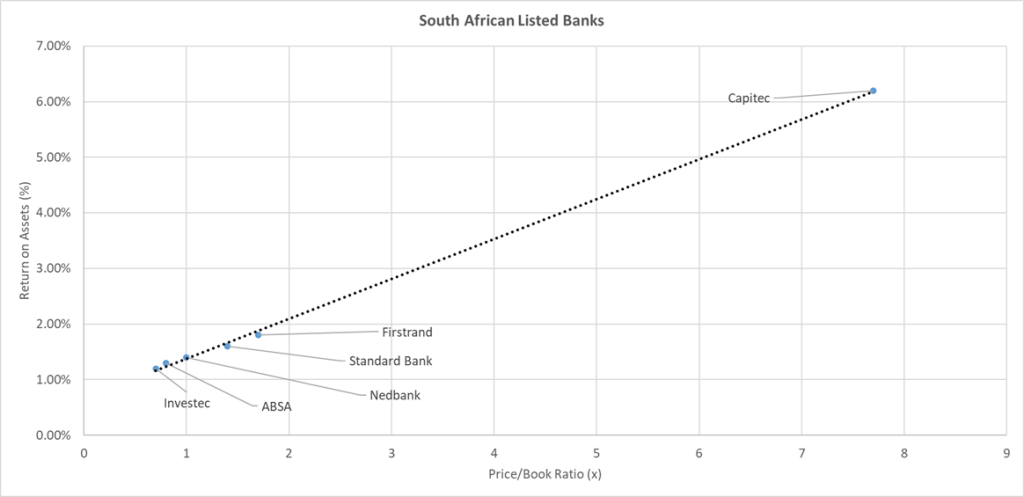
Take Capitec, for instance. The bank is currently trading at a P/B ratio of 7.7, which seems exorbitantly high when juxtaposed against the average P/B of 1.1 for other JSE-listed banks. At first glance, one might conclude that Capitec is overvalued; however, this assessment must consider how well the bank deploys its resources to generate returns. Analyzing the relationship between Return on Assets (ROA) and P/B ratios across the banking sector can reveal whether such valuations are justified.
When plotting a scatterplot of ROA against P/B ratios for local banking stocks, it becomes evident that these institutions are fairly valued relative to their performance in deploying capital. While Capitec might appear expensive, if its profitability remains robust, the high valuation could be warranted. Conversely, banks like ABSA, trading at a P/B of 0.8, might seem undervalued, but their historical performance must be considered before making any conclusions.
Looking ahead, several factors could influence the current pricing of banks. If Capitec’s profitability were to decline, it is likely that its high valuation would adjust downward in tandem. Similarly, should other banks identify operational efficiencies and enhance their returns, we could see upward re-ratings in their valuations. Additionally, macroeconomic variables such as interest rates, economic growth, and credit risk conditions in South Africa will play pivotal roles in determining the future landscape of banking valuations.
Key takeaways from this analysis include the understanding that while current valuations might seem rational based on historical performance, the future is inherently uncertain. Investors should remain vigilant and consider both the qualitative and quantitative aspects of bank performance before making investment decisions.
For traders and investors in the banking sector, the insights drawn from this analysis underscore the importance of not only looking at P/B ratios in isolation but also understanding the underlying factors that drive profitability and capital efficiency. Furthermore, keeping an eye on macroeconomic indicators and their potential impact on the banking environment will be crucial for making informed investment choices.
In conclusion, as we navigate the complex landscape of banking valuations, it is essential to appreciate the nuances behind the numbers. While banks may appear fairly valued based on historical data, the future will ultimately hinge on their ability to adapt and thrive in a dynamic economic setting. Investors should remain astute, evaluating both current performance and potential shifts in market conditions that could reshape the valuation dynamics in the banking sector.